

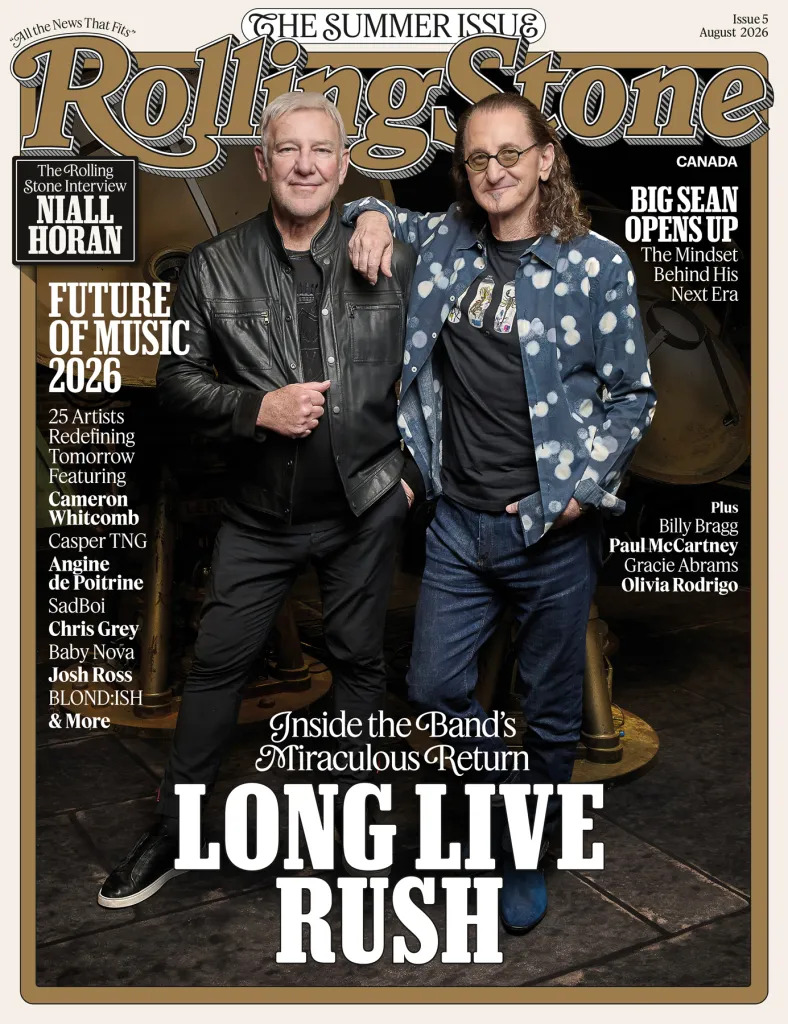
|
Return of the Kings: |
Geddy Lee, Alex Lifeson, and new drummer Anika Nilles tell all about rock’s biggest and most unlikely tour:
“I’m this age now. Can I still do it?”
On their long journey towards becoming Rush again, Geddy Lee and Alex Lifeson pushed past death, illness, age, self-doubt, and for one guy, a weed habit that dated back to 1966. They just didn’t count on the fog.
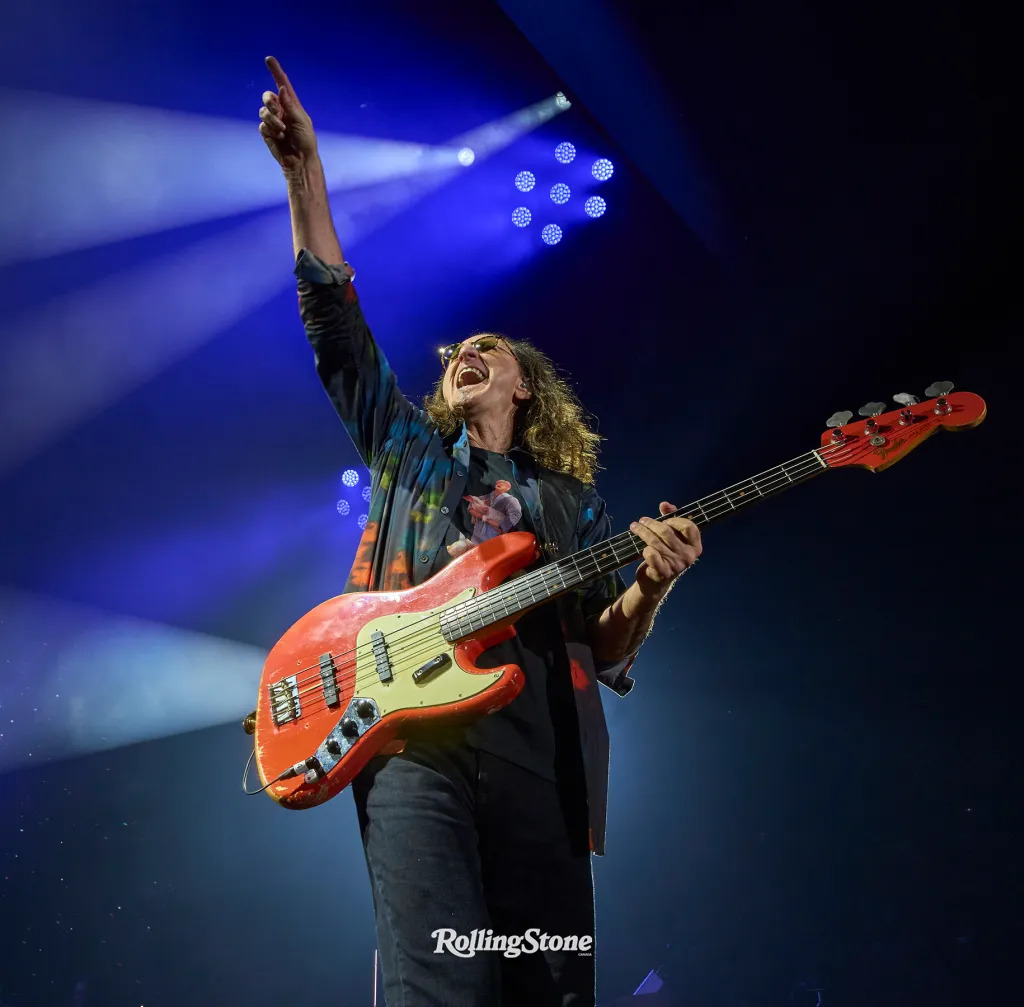 In early June, the resuscitated band was about to begin its first concert in 11 years, the kick-off of its Fifty Something tour. Backstage at Los Angeles’ Kia Forum that Sunday evening, Lee was feeling tense, Lifeson less so. “I was, surprisingly, not really that nervous,” the guitarist says. At showtime, video screens surrounding the stage began to glide upwards, revealing two familiar silhouettes, complete with dual doublenecks, shrouded by thick clouds of smoke. Lifeson put his foot on his volume pedal, ready to unleash the swelling notes that begin 1977’s “Xanadu.”
As more smoke billowed, he could feel his guitar’s twelve-pound weight on his spine, but couldn’t see a single fret. For a second, at least, “not really that nervous” melted into near-panic. A few feet away, Lee glanced down at a small mirror that was supposed to let him watch drummer Anika Nilles. In the haze, his rearview was gone. “We were drowning in fog,” Lee says, laughing at the Spinal Tap absurdity of it all.
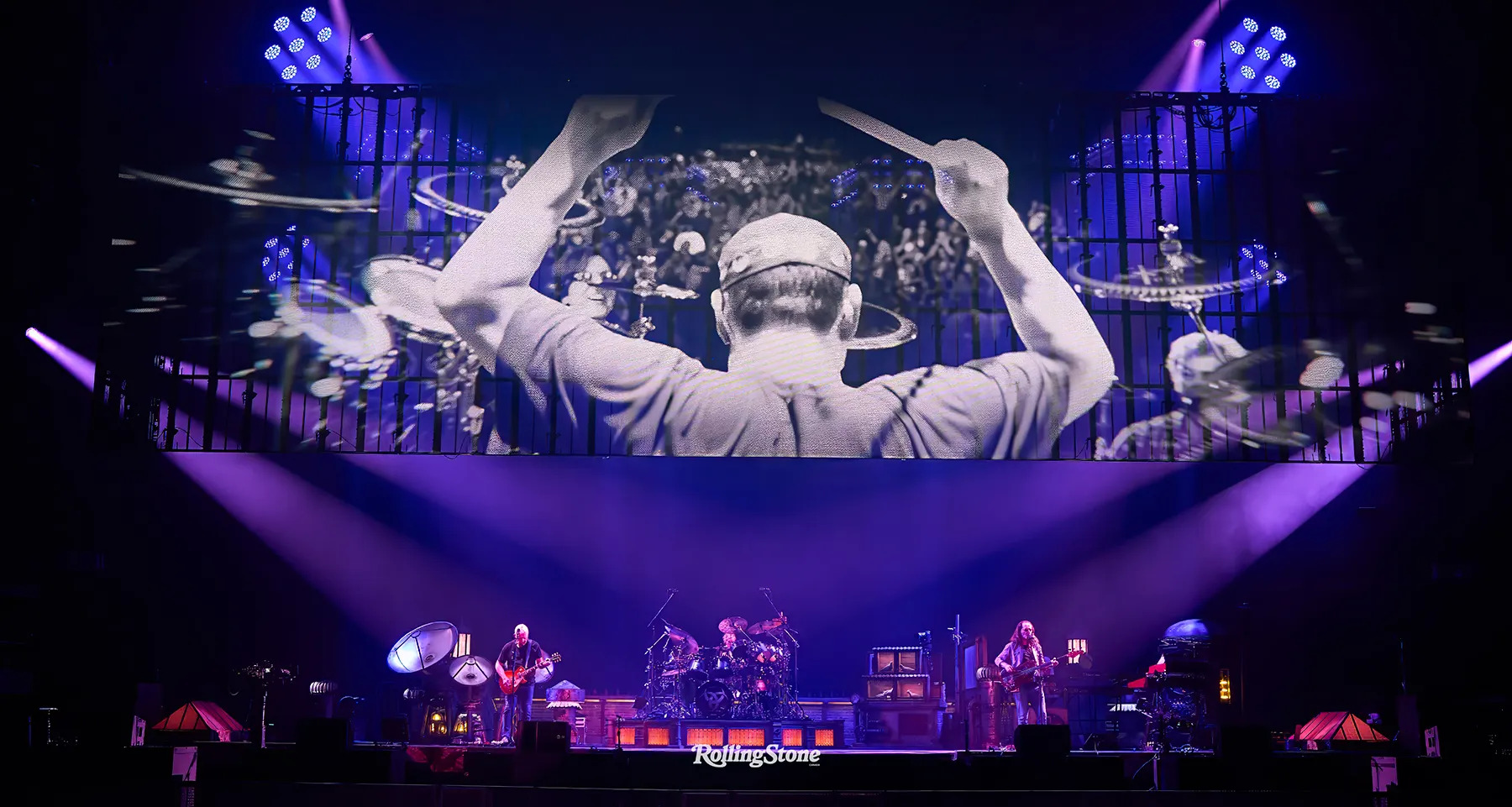
Half-blinded but undaunted, they launched the song. In the opening moments of her very first Rush concert, Nilles whirled through the “Xanadu” intro’s lengthy procession of exclamatory drum fills. A minute in, she was pounding out the tom-tom-heavy accompaniment to a winding riff. Don’t fuck up this fill, she recalls telling herself, just as her left hand lost its grip: “I saw this stick flying over the toms.” She missed a single drum hit, enough to trigger a concerned glance from Lee, before plunging on one-handed. In the same millisecond, she somehow snatched the errant stick out of the air, flipped it over, and kept going. “It happens,” she says, still unfazed. “You drop the stick. As a drummer, you’re used to it.” (“She’s a pro,” Lee adds. “She rose to the occasion on opening night.”)
At age 43, Nilles, a native of Aschaffenburg, Germany, is three decades younger than her new bandmates. When she was born, Rush were about to record their tenth album, Grace Under Pressure. She’s had stage fright in the past, but on the highest-stakes night of her career, was relaxed enough to break into a smile right after that stick recovery. It helped that she meditated for a full 45 minutes before the show, part of a “calming routine.” “In each song part,” she says, “I had to coach myself a little bit through it, especially in the first show, not to fly away.” She tried not to consider the bigger picture. “That all helped not to think too much about how big that seat is and what role I’m filling in it, at the point where I’m sitting on stage. Be in the moment, be present, be focused.”
The seat she’s filling will, of course, always belong to Neil Peart, who died of brain cancer in 2020. That night in L.A. was Rush’s first concert without him since his debut on Aug. 14, 1974. Peart was a one-of-a-kind virtuoso, one of the greatest drummers rock ever knew, his monstrously complex parts so intrinsic to Rush’s sound that the idea of replacing him long seemed unfathomable. He was also their lyricist, lending Canada’s greatest power trio their cerebral ambition and poetic soul, after some loveable sci-fi/fantasy excursions in their earliest days. “We’re only immortal,” Lee sings in 1991’s “Dreamline,” “for a limited time.”
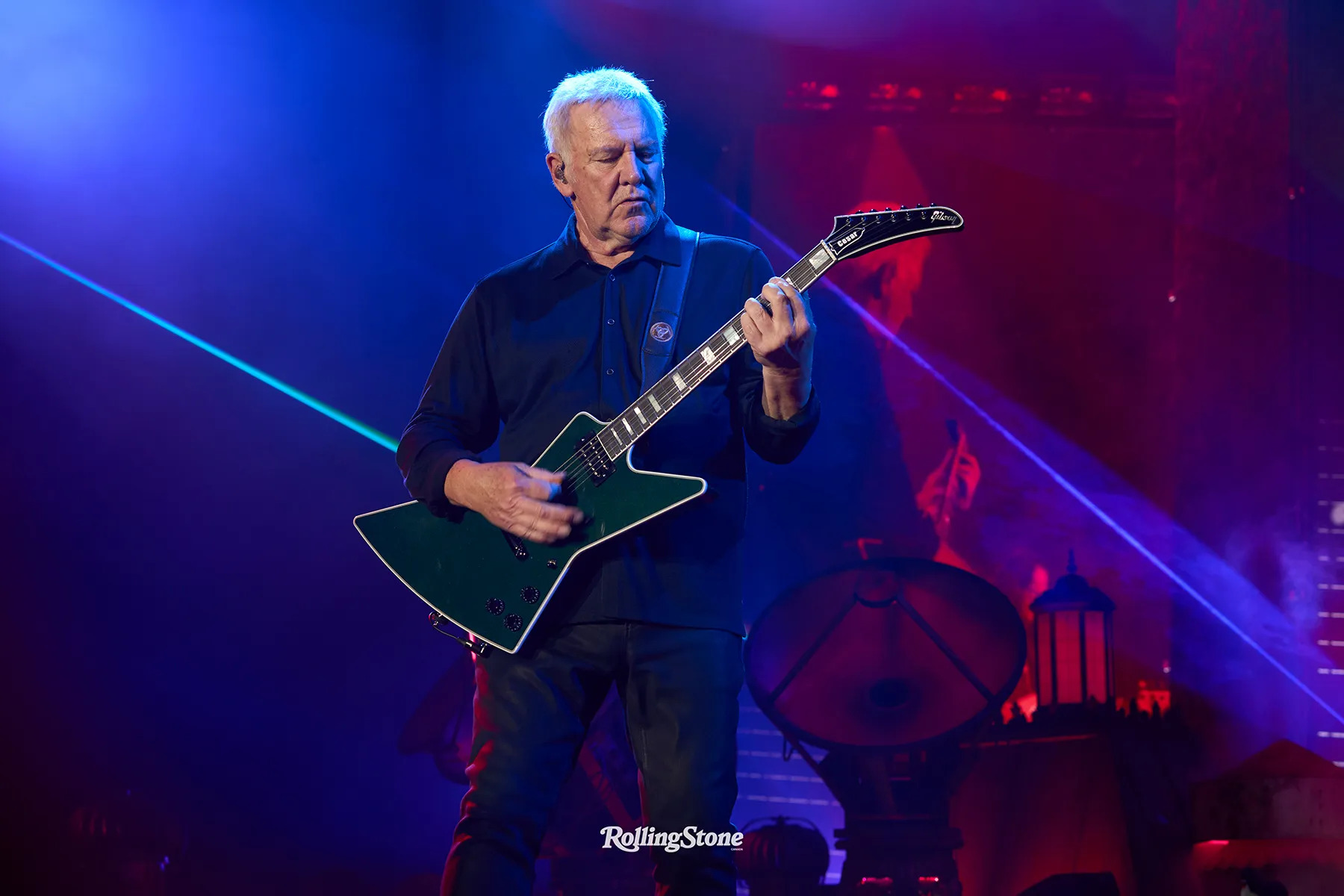 For this tour, though, he was determined to prove otherwise. Not only was Rush’s frontman, bassist, and designated taskmaster reviving a vanished band, but he had over-the-top, nearly masochistic ambitions for its new incarnation. “It’s how I’m built,” Lee says. “I’m crazy.” The musicians, now also including keyboardist Loren Gold, would have to learn over 40 songs, many of them stuffed with more musical twists than some bands’ entire albums. There are four alternating setlists, each stacked with the trickiest material of their notoriously tricky-to-play catalog – the full first side of 2112 was just the start. Gold’s presence at least rescued Lee from playing bass pedals with his feet during every keyboard part, but he’s still grabbing some signature synth riffs for himself.
“Why do you do it? It’s a test,” says Lee, who turned 73 in July. “It’s howling at the moon! It’s saying, ‘I’m this age now. Can I still do it?’ Those moments of self-doubt, of course we all have those. Anika has those, and she’s much younger than us, apparently. That’s just being a human. You always doubt that you can stretch and play at your apogee.”
For Lifeson, that struggle was real and visceral. “In the last month of rehearsals,” he says, “there were times I was sitting on the edge of my bed at two o’clock in the morning thinking, ‘Did I make the right decision? Can I do this? Can I play? Am I good enough?’ It wasn’t really until Sunday, when we played that gig, that it all kind of came down this funnel and spilled out. It was at that moment that I thought, ‘Yeah, this has all been worth it. This is where I really am happy to be.’ I’m tired this week. But I’m really, seriously happy.”
Lee wanted to get back on stage from the moment the band said goodbye in August of 2015, but confirming the tour meant many months of grim-faced work. His daughter, Kyla, said she hardly saw a real smile from him for a year and a half. “In my history as a musician, I don’t think I’ve ever rehearsed quite as much as an individual, and also as a band,” Lee says. “Of course, we needed to, because it was a monumental task… In the last month and a half, I think at one point we did the show 24 times in 27 days. It’s been a long time since we were on a stage, and we put so much of our heart and soul into shaping the show and perfecting our parts. And when the curtain goes up, you just never know which version of you is gonna show up.”
Opening jitters aside, the first show turned out to be a triumph, with the crowd instantly, even gratefully, embracing Nilles. By nights three and four, any remaining nerves had burned off. Lifeson was roaming the stage, trying to make the new drummer laugh. “We’re much looser than we’ve been before,” Lee says. “Goofier.”
More than once, Lee couldn’t help leaping in the air as he thumped out, say, the riffs of “Red Barchetta” or the climax to “La Villa Strangiato.” Did anyone suggest that, for a septuagenarian with many months of shows ahead around the world, including two homecoming runs through Canada, leaving the ground might not be the best idea? “Yes,” Lee says, smirking. “My trainer. My wife. My daughter.”
 JUST TWO YEARS AGO, Lifeson told me his mind was made up. “There’s no chance that we’re going to get a drummer and go back on the road as the rebirth of Rush or something like that,” he said in May of 2024. He and Lee had just started to play Rush songs in private again, but Lifeson insisted it was just for fun. He was recording with a band called Envy of None, but otherwise seemed like a man at peace with semi-retirement. “I really would feel like we were doing an injustice to our fans and that would be just a money grab.” A few months later, in another interview, he went even further, calling the R40 tour a high point: “I guess I’d rather be remembered for that legacy than returning as the top Rush tribute band.”
In September of 2022, at two tribute concerts for late Foo Fighters drummer Taylor Hawkins, Lee and Lifeson performed together for the first time since Peart’s death, with a revolving crew of drummers. Earlier, they had made it clear that Rush was gone: “That’s finished, right? That’s over,” Lee told me in late 2020. After feeling their songs under their fingers again, they weren’t so sure, and it didn’t hurt that Paul McCartney urged them to get back on the road backstage after the first show, at Wembley Stadium. In the aftermath, Lifeson got briefly excited about the idea, then seemed to change his mind. Lee kept at him, and along the way, began to find Lifeson’s interview comments increasingly baffling. “Al is great at saying one thing to your face and then saying something else in public,” Lee says now. “You’re like, ‘Oh, that’s interesting.'”
Lifeson shrugs. “Yeah, I kind of do do that.” They’re sitting side by side in the dark basement studio of the Sunset Marquis in West Hollywood, their go-to hotel in the Seventies.
Lee has boundless affection for his best friend, but he found one part of Lifeson’s public comments intolerable. “I know how he feels and how he’s felt for a long time,” Lee says. “We’re friends first. But… when I heard this thing about the tribute? It’s like, ‘They’re your songs, motherfucker!’ It’s not a tribute band! We own those songs as much as we did with Neil. And they’re part of us. They’re part of your soul. They’re part of your heart. And when we started playing them together again, that kind of woke up in him.”
Lifeson thinks he was trying to send messages through the press that he didn’t have the heart to say to Lee’s face. “Maybe I was trying to send a bit of a signal,” he says. “I wanted to create this wall that I didn’t have to climb over, by saying, ‘Oh no, I don’t wanna be in a Rush tribute band,’ blah, blah, blah.”
-| Click HERE for more Rush Biographies and Articles |-